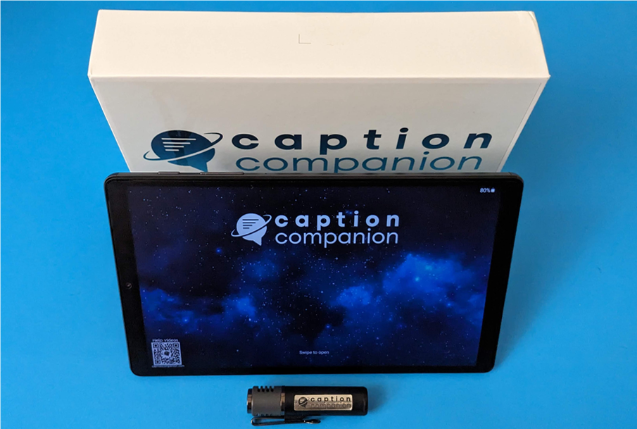
 When Angie Fugo of the Rotary Club of World Disability Advocacy attended the Leadership Training Institute in January, she brought her Caption Companion speech-to-text device along. This 5” x 8” tablet transforms spoken language into readable text for people who can’t hear well and those who need or prefer to read for understanding or to follow along.
When we talk about creating more inclusive Rotary clubs, accessibility needs to be part of the conversation. Sometimes, small changes in how we conduct our meetings can make a tremendous difference in whether someone feels included, connected, and truly part of the group.
Past District Governor Johnny Ahern saw the value of a Caption Companion, a speech-to-text device designed to assist people with hearing loss, and proposed that the District purchase one for use at District meetings and events. The device has arrived and is now available for clubs and District events.
Angie Fugo, an Americans with Disabilities Act (ADA) Coordinator and Membership Chair of the Rotary Club of World Disability Advocacy, also recommends that individual Rotary clubs consider having access to one.
I sat down with Angie for a Q&A about hearing accessibility and what we can do to make our Rotary meetings more welcoming and inclusive.
Penny: What’s most important as we think about the accessibility of our club meetings?
Angie: I’d start with hearing. It’s important for understanding and connection. Helen Keller said, “Blindness separates people from things; deafness separates people from people.” And for those of us who hear, it’s our primary means of communication.
Here’s a challenge: Close your eyes during a meeting. Can you still follow along? Most likely you can. Now open your eyes and put your fingers firmly over your ears—or, if you wear hearing aids, remove them. Suddenly, your friends become talking heads. You’re there, but you’re not really part of the conversation because you’re missing all or most of what’s being said.
It gives you just a small glimpse into what it can be like to live with hearing loss.
Penny: So, you wear hearing aids. Don’t they correct your hearing?
Angie: I wish! Hearing aids are just that—aids. They don’t correct hearing; they amplify sound. Unlike glasses or contacts, which can make vision clearer, hearing aids don’t necessarily make sound clearer.
They work best when you’re within about six feet of a speaker. In many situations, people who use hearing aids still need additional listening assistance. But regardless of the technology, in every hearing situation, our communication partners’ kindness and patience are essential.
Hearing with hearing loss can be like trying to see the road through bright headlights in a dense fog. Or it can feel like trying to piece together sentences from a bowl of alphabet soup—hearing bits and pieces and trying to determine whether someone said t or d, p or f, while the conversation keeps moving.
And doing that for hours throughout the day can be physically and emotionally exhausting.
Penny: So, it’s not all on you. We have some responsibility to help you hear, too, don’t we?
Angie: Absolutely.
At first, I was sad to lose most of my hearing. But I’ve gained a new appreciation for the interdependence of us all. That’s one of the benefits of having a disability—you can connect with people in new ways and sometimes at deeper levels.
Hearing is especially an interdependent sense. We always need a communication partner. One of the greatest joys is when someone asks instead of assumes what I need in order to hear them—and then takes that extra step to help.
Penny: So how does the Caption Companion help?
Angie: The Caption Companion is especially useful because it can work with or without an internet or power connection. I use mine for meetings where I’m beyond the best range of my hearing aids—more than about six feet from the speaker.
It is the first and, so far, only device certified by the Global Alliance for Speech-to-Text Captioning. It comes with a SmartMic for improved accuracy and flexibility and can also connect to room microphone or audio systems.
If several people need speech-to-text assistance, it can also be connected to a larger screen so captions can be displayed for the entire room.
Penny: That could provide accessibility for many people. So, how do we make our Rotary clubs more accessible?
Angie: I recommend that clubs advertise the accessibility they already provide and continue working to increase it. And remember, much of hearing accessibility isn't about technology—it’s about behavior.
For the technology side, clubs can:
- If your meeting space has an induction loop or assistive listening system, make sure it’s ready to use, has fresh batteries, and that someone knows how to operate it.
- Consider getting a Caption Companion and letting members and guests know it is available.
- Display captions during webcasts, hybrid meetings, and presentations using tools such as Microsoft PowerPoint and Google Slides.
- Turn on the CC/captioning feature when showing YouTube or other videos.
But perhaps even more importantly, there are things all of us can do—and they cost nothing.
Have a designated meeting leader and clearly identify roles on the agenda and in meeting materials. Send the agenda and any speeches or words that will be read aloud ahead of time whenever possible.
Keep control of the meeting. Limit background noise and interruptions, and avoid having multiple people speak at once. Use transitions so people know when the conversation is changing. If something is important, repeat it—and if necessary, spell it or rephrase it.
Give people cues when changing topics: “Next, we’ll be moving on to…”
And one more thing: laughter.
When everyone laughs, auditory processing can slow down. People who have hearing loss may hear the laughter before they understand the punchline, and captions can become garbled. So if you tell a joke and someone misses it, repeat it for us!
These kinds of behaviors are some of the loudest kindnesses we will ever hear.
Penny: Thank you, Angie. This sounds a lot like Rotary’s commitment to Service Above Self.
Angie: You’re welcome, Penny. Yes—it’s about serving our fellow Rotarians.
And when clubs advertise that they offer hearing assistance and other accessibility options, more people may feel comfortable walking through the door. They can hear, understand, participate, join—and most importantly, feel like they belong.
And isn’t that exactly what we want Rotary to be?
A Final Thought for Every Rotary Club
Accessibility isn't simply about purchasing equipment or checking a box. Inclusion is about removing barriers that prevent people from fully participating.
A member shouldn't have to struggle to hear a presentation. A guest shouldn't have to wonder whether they can participate in the conversation. And someone with a disability shouldn't have to explain repeatedly what they need in order to belong.
Sometimes inclusion is a piece of technology. Sometimes it's turning on captions.
And sometimes, it's simply slowing down, speaking clearly, reducing background noise, repeating something, or asking:
“What can I do to make this easier for you?”
Those small actions can make a very big difference.
Angie Fugo is Membership Chair of the Rotary Club of World Disability Advocacy, International Liaison for the Association of Late Deafened Adults, a ChurchEar board member, and a member of Audible Talkers Toastmasters, an online speaking and camaraderie club for people with and without hearing loss. Angie can be reached at angiefugo@gmail.com